



Waking up with a stiff lower back or standing up from your desk with a dull, tight ache is one of the most common physical complaints adults experience. When your lumbar spine feels tight, gentle movement is almost always better than staying still.
However, not all stretches belong in your morning routine, and stretching alone is rarely a magic cure.
Below, we explain why your spine feels so tight when you first get out of bed, what research says stretching actually accomplishes, and 11 gentle stretches for lower back pain and stiffness available right inside the Sporty Doctor app.
Why Your Lower Back Is Stiffest in the Morning
If you notice that your back feels like a rusty hinge during your first hour out of bed, you are experiencing a well-documented physiological phenomenon.
While you sleep horizontally, your spinal discs are unloaded. Without the downward pull of gravity, these intervertebral discs absorb fluid from surrounding tissues through osmotic pressure. A study of 21 volunteers in Spine demonstrated that lumbar forward bending is about 5° less in the early morning because discs are at peak fluid volume, placing higher bending stress on discs early in the day.
Because your discs are swollen with fluid when you wake up, aggressively rounding your back or reaching for your toes right out of bed can irritate sensitive spinal structures. A randomized trial of 85 people with chronic low back pain showed that simply avoiding hard forward bending in the early morning reduced pain.
For morning stiffness, the goal is not to force end-range flexibility. Instead, you want gentle, unloaded mobility to warm up connective tissues and safely circulate fluid. A warm shower before stretching is reasonable, since the American College of Physicians guideline recommends heat for recent low back pain.
What Lower Back Stretches Can and Cannot Do
Before diving into a routine, it helps to be honest about what stretching does.
Stretching can:
- Temporarily calm muscle guarding and tension.
- Improve joint range of motion and comfort.
- Signal your nervous system that movement is safe.
- Ease postural tightness after prolonged sitting.
Stretching cannot:
- Rebuild weakened trunk stability.
- Realign your spinal anatomy.
- “Cure” structural disc herniations or spinal stenosis.
In fact, a network meta-analysis of 89 randomized controlled trials found that stretching alone did not differ from control for pain or function; Pilates, strength, and motor-control work produced the greatest clinical improvements.
A 2021 Cochrane review of 249 trials confirmed with moderate certainty that structured exercise reduces chronic low back pain compared to no treatment.
Think of stiff lower back stretches as your entry point: they clear morning tension and restore comfortable mobility so you can stay active throughout the day. However, stretching alone isn’t enough to build lasting stability. Once your acute tightness settles, pair your mobility work with targeted physical therapy exercises for lower back pain to strengthen your core and protect your spine long-term.
Gentle Bed and Floor Stretches for Early Morning Stiffness
These lower back stretches in bed and on the floor are designed to be done lying flat on a firm mattress or mat. Because your body weight is supported, they place virtually zero compressive load on your lumbar spine.
Supine Knee Side-to-Side
Lying on your back with knees bent, letting the knees drop side to side provides relaxed rotation through your hips and lumbar spine while gently engaging your obliques and hip rotators.
How to do it
- Lie on your back with your knees bent and feet flat on the surface.
- Drop your knees slowly to one side while keeping your shoulders down.
- Return to center.
- Lower your knees the other way, alternating smoothly for 10 to 12 total repetitions.
Supine Hip Flexor Stretch
Lying on your back near the edge of a bed or firm couch and letting one leg hang stretches the front of the hip—targeting your iliopsoas, rectus femoris, and quadriceps—to ease tightness from hours of sitting and lying curled up.
Caution: If you feel tingling down the hanging leg, ease off.
How to do it
- Lie on your back near the edge of a bed or firm couch.
- Draw one knee gently toward your chest.
- Let the other leg hang off the edge.
- Breathe and relax into the front of that hip, then switch sides.
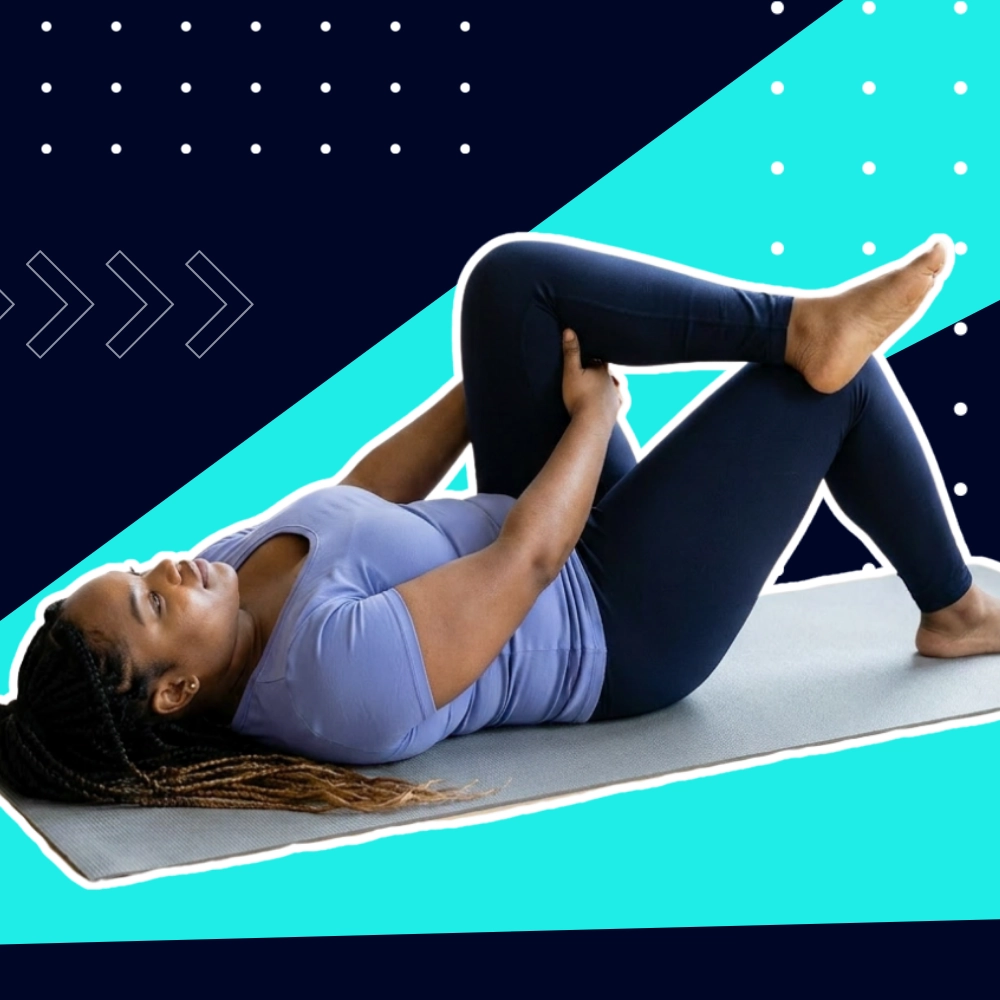
Lying Knee to Chest Stretch
On your back, pulling one knee toward your chest gently lengthens your gluteus maximus and lower spinal extensors, easing lower back tension while keeping your spine safely supported.
How to do it
- Lie on your back with both knees bent.
- Gently pull one knee toward your chest with your hands behind your thigh.
- Keep the other leg relaxed and hold 20 to 30 seconds.
- Release slowly, then switch sides.
Decompressing Stretches to Restore Spinal Mobility
Once your body is awake and moving, these unloaded positions use controlled breathing to move your spine through gentle flexion and extension.
Cat Cow
Moving your spine through gentle flexion and extension on hands and knees mobilizes your erector spinae, multifidus, and abdominal muscles to reduce stiffness throughout your entire back. A 2022 Cochrane review of 21 yoga trials involving 2,223 people showed small improvements in pain and function compared to no exercise.
Caution: If you have an acute herniated disc, stick to the gentle arch and skip the rounding while pain is acute.
How to do it
- Start on your hands and knees with hands under your shoulders and knees under your hips.
- Arch gently, lifting your chest.
- Round your spine upward toward the ceiling.
- Move slowly with your breath for 8 to 10 slow cycles.
Child’s Pose
Kneeling, sitting your hips toward your heels, reaching your arms forward, and relaxing your chest down stretches your latissimus dorsi, spinal erectors, and glutes in a restful position.
Caution: Go easy on this stretch if you have an acute herniated disc, because forward bending can aggravate an acute disc.
How to do it
- Kneel with big toes touching and knees slightly apart.
- Sit your hips back toward your heels.
- Reach your arms forward and relax your chest toward the floor.
- Rest your forehead down and breathe deeply for 30 to 45 seconds.
Happy Baby Pose
Lying on your back with the floor supporting your spine gently opens the hips and inner thighs—targeting your adductors, hamstrings, and gluteus maximus—while easing lower back tension.
Caution: Go easy with an acute herniated disc, as forward bending can aggravate it.
How to do it
- Lie on your back and bring your knees toward your chest.
- Hold the outer edges of your feet, arms inside your knees.
- Gently draw your feet down as your knees move toward the floor.
- Keep your head and spine relaxed and breathe slowly.
Targeted Hip and Tissue Stretches to Ease Tension
The muscles surrounding your pelvis work in close harmony with your lumbar spine. While tight muscles do not directly cause back pathology, restoring mobility through the glutes and hips helps your body move more comfortably.
QL Tissue Release
Lying on your side with a massage ball (a tennis ball works) under your waist between your lowest rib and pelvis, gently rolling a small area directly releases the quadratus lumborum to ease deep muscular tension along the side of your lower back.
How to do it
- Lie on your side with a massage ball under your waist, between your lowest rib and pelvis.
- Gently roll over a small area for 30 to 60 seconds.
- Keep the ball off your spine, ribs, and hip bone.
- Switch to the opposite side.
Figure Four Stretch
On your back or seated, crossing an ankle over the opposite knee and drawing your legs in targets your piriformis and deep gluteal muscles without twisting your lower spine.
How to do it
- Lie on your back with both knees bent (or sit tall in a chair).
- Cross one ankle over the opposite knee.
- Gently draw the legs toward you until you feel a stretch in the outer hip and glute; hold 20 to 30 seconds.
- Release, then switch sides.
Banded Hamstring Stretch
On your back, looping a band or towel around one foot and lifting the leg lengthens your hamstrings and calves while keeping your pelvis and lower back fully supported.
Caution: Skip this stretch if you have sciatica, because it puts tension on the sciatic nerve.
How to do it
- Lie on your back and loop a band or towel around one foot.
- Lift the leg toward the ceiling, keeping the knee relaxed.
- Stop at a comfortable pull behind the thigh and hold 20 to 30 seconds.
- Lower slowly, then switch sides.
Desk and Standing Stretches for Midday Stiffness
Static sitting leaves your hips in a shortened position. The Physical Activity Guidelines for Americans emphasize moving more and sitting less throughout the day. These two movements are easy to perform during a brief workday pause.
Standing Hip Flexor Stretch
In a split stance with your front knee slightly bent and back leg straight, pressing your hips forward opens your iliopsoas and quadriceps at the front of your hip without requiring you to kneel on the floor.
How to do it
- Stand in a split stance with your front knee slightly bent and back leg straight.
- Press your hips forward until you feel a gentle stretch along the front of your back hip.
- Keep your chest upright and your lower back neutral.
- Hold for 20 to 30 seconds, then switch legs.
Standing Hip Rotations
Small, controlled hip circles activate your hip rotators and gluteus medius, loosening stiff hips after prolonged sitting without loading the lower back.
How to do it
- Stand holding a desk or chair for support.
- Lift one knee.
- Rotate the hip in small circles.
- Change direction, then switch sides.
Which Stretches to Skip With a Specific Back Condition
Every stretch on this page was medically reviewed by Dr. DeMatas as safe across common back conditions, with a few form cues.
- Herniated disc: In Cat Cow, do the gentle arch and skip the rounding while pain is acute. Go easy on Child’s Pose and Happy Baby Pose, because forward bending can aggravate an acute disc.
- Sciatica: Skip Banded Hamstring Stretch, because it puts tension on the sciatic nerve. Stop Figure Four or Supine Hip Flexor Stretch if symptoms travel down the leg.
- Lower back arthritis and lower back strain: All 11 are fine in a comfortable range.
- Safe for all four: Supine Knee Side-to-Side, Lying Knee to Chest Stretch, QL Tissue Release, Standing Hip Flexor Stretch, Standing Hip Rotations, and Figure Four Stretch (stop if symptoms travel down the leg).
Popular Stretches That May Not Be Safe for Your Back
You’ll see these on many lower back stretch lists; they can work for some people but commonly aggravate certain conditions.
- Sphinx Pose, Cobra, and press-ups: The arching can aggravate lower back arthritis.
- Pelvic tilts: The tuck is a small forward bend that often aggravates an acute herniated disc.
- Seated and chair spinal twists: Twisting can sometimes aggravate a herniated disc.
- Standing toe touches: Forward bending under body weight, especially first thing in the morning.
Movement should feel relieving or neutral; stop if a stretch causes sharp pain or symptoms that travel into the glutes or legs. If you’re not sure what’s behind your back pain, go by symptoms, and see a doctor if pain or tingling down the leg persists.
Every exercise in the Sporty Doctor app is medically reviewed by Dr. DeMatas and comes with video guidance, so you can follow along with the right form.
When Lower Back Stiffness Needs a Doctor
Most mechanical stiffness improves within a few weeks of consistent gentle movement. However, certain symptoms warrant a prompt medical evaluation.
Consult a healthcare professional if you experience:
- Neurological Signs: Numbness, tingling, or muscle weakness traveling down your leg, into your calf, or your foot.
- Red-Flag Symptoms: Sudden bowel or bladder dysfunction, or numbness around your groin or saddle area (which can indicate cauda equina syndrome, requiring emergency care).
- Trauma or Unexplained Symptoms: Back pain following a significant fall or motor vehicle accident, pain accompanied by fever, or unexplained weight loss.
- Inflammatory Back Pain Indicators: Classification criteria based on clinical history identify that morning stiffness lasting longer than 30 minutes, waking you up in the second half of the night, and improving with exercise but not with rest can indicate systemic inflammatory back conditions such as axial spondyloarthritis.
If your back discomfort persists for more than six weeks without improvement, schedule an evaluation with your primary care physician, a sports medicine physician or physical therapist for personalized diagnostic guidance.
Build a Sustainable Daily Routine
Consistency beats intensity every single time. Spending just five minutes in the morning on gentle floor movements and taking short standing breaks throughout your workday can dramatically reduce daily stiffness.
All 11 of these best stretches for lower back pain feature complete, guided video demonstrations inside the Sporty Doctor app. The free plan gives you 10 exercises picked for you, and full workouts are part of the annual plan.
Discover the best stretches for your back in the Sporty Doctor app.

Dr. DeMatas practices holistic, evidence-based family medicine that focuses on treating injuries and transforming lives through prevention, rehabilitation, and diet. She is a licensed, practicing Physician in Jacksonville, FL.
