

How to Do the Banded Donkey Kick
Start on your hands and knees, hands under shoulders, knees under hips.
Loop the band around your thighs, just above your knees.
Keeping the knee bent, kick that heel up toward the ceiling.
Keep your hips level and square to the floor.
Return slowly to the start.
Stop the kick when your thigh comes in line with your trunk. Pushing your leg higher than your hip does not work the glute more; instead, your pelvis tips forward and your lower back arches to fake the extra height. Before you lift your knee off the mat, gently draw your belly button in toward your spine so your ribs and pelvis stay locked together. A small 2015 study in the Journal of Physical Therapy Science found that drawing the belly in during prone hip extension increased gluteus maximus activity while cutting down low-back muscle overactivity in adults with an exaggerated lumbar curve.
Aim for 2 to 3 sets of 10 to 15 reps per leg, taking a full two or three seconds to lower your knee against the pull of the band.
Keep Your Lower Back Out of the Kick
Good form on the banded donkey kick means moving from your hip while your spine and pelvis stay quiet, which keeps the load in your glutes and prevents low-back strain. Watch for these four common mistakes on the mat.
- Low-back arch: Letting your lower back sag to lift the leg higher shifts tension off the glute and into the lumbar spine, which can irritate your back.
- Hip rotation: Rotating your pelvis open toward the kicking leg turns the move into a trunk twist and unloads the glute.
- Band slipping: Placing the band over your kneecaps or too high on your thighs causes it to roll or bunch mid-set instead of sitting flat just above the knees.
- Rushing reps: Kicking up fast and letting the band yank your knee back down relies on elastic recoil instead of your hip extensors.
Why the Bent Knee and Band Matter
Hours in a desk chair leave your hip flexors short and your glutes underused. When the weekend arrives and you head out for a run, hike, or long walk, your lower back or knees often absorb the extra stress. Because you are on all fours rather than squatting under a load, the banded donkey kick lets you build hip extension strength without heavy compression across a cranky knee or sensitive spine.
Keeping the working knee bent at 90 degrees is the key mechanical detail. A straight-leg kick lets your hamstrings take over, whereas bending the knee shortens the hamstrings so they cannot dominate the lift. That leaves your gluteus maximus (the largest muscle of the buttock) to drive your heel toward the ceiling. A 2009 EMG study in the Journal of Orthopaedic & Sports Physical Therapy of 21 healthy adults compared 12 therapeutic hip exercises and ranked bent-knee quadruped hip extension among the top movements for gluteus maximus recruitment.
Looping a resistance band around your thighs just above the knees changes the resistance profile in a way an ankle weight cannot. As your kicking thigh separates from the kneeling leg, the band stretches tightest at the top of the lift, right where the gluteus maximus reaches full contraction. Strong glutes share mechanical load with your lower back when you hinge or lift and help control how your thigh tracks when your foot hits the ground. If kneeling bothers your knees or wrists, pair or alternate this move with the glute bridge to train hip extension lying on your back.
Both Hips Work on Every Rep
While the kicking leg gets most of the attention, the banded donkey kick trains both sides of your pelvis at once. On the moving leg, the gluteus maximus drives your thigh upward against the band while the hamstrings along the back of the thigh hold your knee bent. Deep abdominal muscles, including the transversus abdominis and rectus abdominis, brace your trunk so your lumbar spine stays quiet while your hip extends.
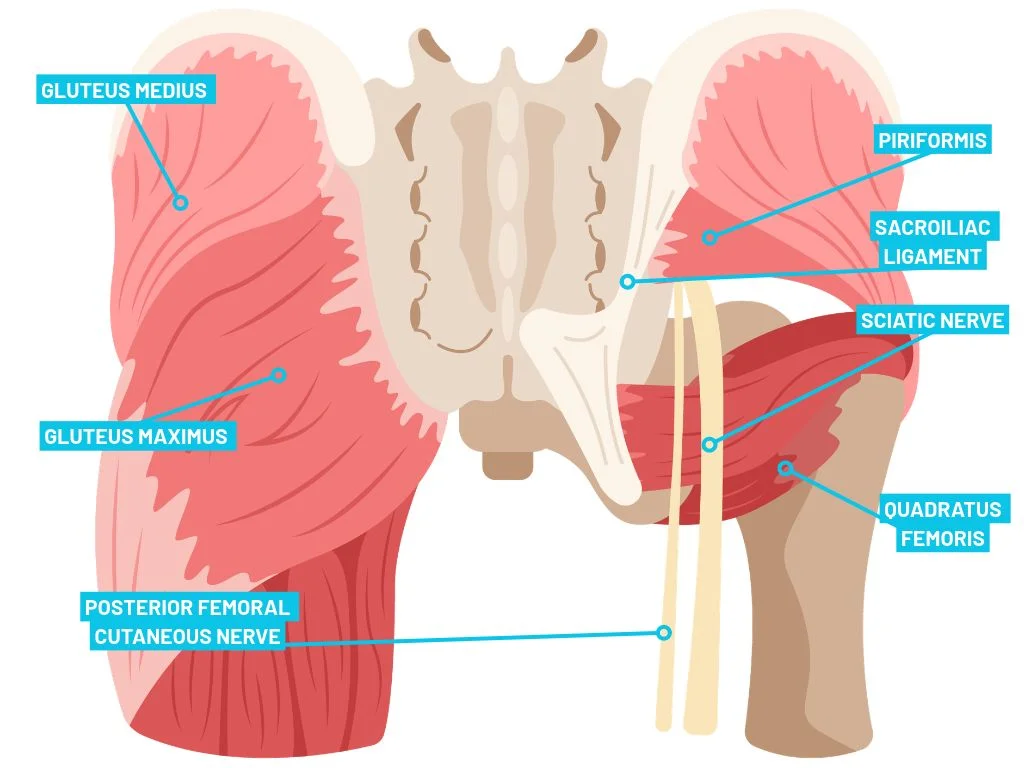
At the same time, the gluteus medius on the outer side of the hip works on both legs. It assists the lift on the kicking side and fires on the kneeling leg to keep your pelvis level against gravity. A 2011 EMG study in the International Journal of Sports Physical Therapy of 26 adults across 18 rehabilitation exercises showed meaningful gluteus medius activity on both the moving leg and the stationary stance leg during quadruped hip extension, making this exercise a practical part of hip abductor strengthening.
Adjusting the Load and Position
If your pelvis tips or twists against the pull of the band, set the band aside and practice bodyweight donkey kicks until you can hold your hips level for a full set. If supporting your weight on flat palms bothers your wrists, make fists or lower onto your forearms with your elbows stacked under your shoulders. Once bodyweight and light-band sets feel steady, hold a two-second pause at the top of each kick, take four full seconds to lower your knee, or move up to a heavier band.
When to Ease Off
You should feel deep muscular effort in the back and side of your hip, not a pinch in your lower back. Stop the set if low-back pinching continues after you brace your core and lower your kick height, if wrist pain does not ease on your forearms, or if you feel sharp pain in the front of the hip, and check with a clinician. If being on hands and knees aggravates your back right now, start with gentler exercises for lower back pain before returning to floor work on all fours.
- Kim TW, Kim YW. 2015. J Phys Ther Sci. Effects of abdominal drawing-in during prone hip extension on the muscle activities of the hamstring, gluteus maximus, and lumbar erector spinae in subjects with lumbar hyperlordosis.
- Distefano LJ, Blackburn JT, Marshall SW, Padua DA. 2009. J Orthop Sports Phys Ther. Gluteal muscle activation during common therapeutic exercises.
- Boren K, Conrey C, Le Coguic J, Paprocki L, Voight M, Robinson TK. 2011. Int J Sports Phys Ther. Electromyographic analysis of gluteus medius and gluteus maximus during rehabilitation exercises.
