

How to Do the Reverse Clamshell
Lie on your side with your knees bent and stacked, and your hips stacked one directly over the other.
Keep your knees pressed together throughout the entire movement.
Lift your top foot upward toward the ceiling by rotating from the hip socket.
Lower your foot back down slowly with control.
Expect a much smaller range of motion here than in a traditional clamshell. Because your thigh bone is rotating inward inside the hip socket with your knees pinned together, your foot may only lift a few inches before your pelvis tries to take over. Aim for 2 to 3 sets of 10 to 15 slow reps per side, pausing briefly at the top before taking two full seconds to lower, and add a light mini band just above your ankles once bodyweight reps feel effortless.
Why Your Knees Stay Glued Together
Good reverse clamshell form isolates rotation inside the hip socket while your pelvis and lower spine stay completely still. When you force the foot higher than your hip allows, other joints compensate, which drops glute activation and risks irritating your lower back, knee, or the front of your hip. Watch for these four form breakdowns on every set.
- Letting your knees drift apart. Even an inch of separation shifts the drill back into external rotation and turns it into a standard clamshell.
- Rolling your top hip backward. Rocking your pelvis back makes it look like your foot is lifting higher, but that extra height comes from twisting your lower spine rather than rotating your hip socket.
- Dropping the foot on the way down. Using momentum skips the slow lowering phase where your lateral hip stabilizers do their hardest work.
- Cranking from the ankle or bracing your neck. Tilting your foot sideways or clenching your jaw to force extra range adds strain without rotating the thigh bone any further.
Reverse Clamshell vs Clamshell
If you have done plenty of floor hip work, you already know the clamshell exercise. A standard clamshell keeps your feet together and opens the top knee like a book, training hip external rotation to work the deep posterior rotators, gluteus medius, and gluteus maximus. The reverse clamshell flips the pivot point by keeping your knees together and lifting the top foot, which drives hip internal rotation instead.
Hours of sitting and miles of straight-ahead running or cycling tend to rob the hip of internal rotation long before external rotation feels tight. Pairing 2 to 3 sets of slow reverse clamshells with regular clamshells moves stiff hips through both directions of rotation on the floor, waking up the deep glutes and smoothing out joint motion without heavy spinal load.
The Muscles Behind Hip Internal Rotation
When your top knee stays anchored against your bottom leg, lifting your foot rotates the femur inward in the socket. The primary reverse clamshell muscles worked are the anterior (front) fibers of the gluteus medius and the gluteus minimus lying directly beneath it. While the whole gluteus medius abducts the hip, its front fibers angle across the pelvis in a way that pulls the thigh bone into internal rotation.
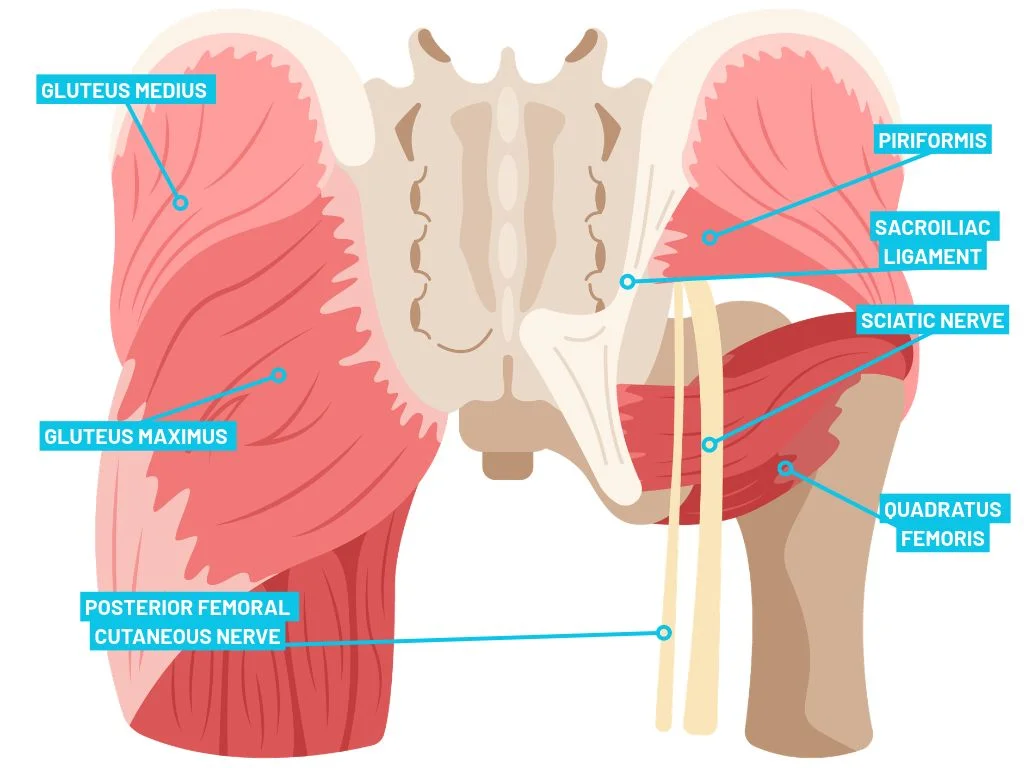
Side-lying hip drills are uniquely effective at isolating this lateral wall of the pelvis. A 2020 systematic review and meta-analysis in the International Journal of Sports Physical Therapy evaluated muscle activation across common rehab drills and found side-lying hip exercises among the highest activators of the gluteus medius and gluteus minimus segments.
You also recruit the tensor fasciae latae (TFL), the small muscle at the front-outer pocket of your hip that feeds into the IT band. A 2013 fine-wire EMG study of 20 healthy adults in the Journal of Orthopaedic & Sports Physical Therapy measured hip exercises including the clam and showed that side-lying movements load the TFL alongside the glutes. Keeping your hips stacked directly on top of each other prevents the TFL from dominating the movement so the anterior gluteus medius and gluteus minimus do their share.
Why Runners and Lifters Need This Movement
Stretching a hip that feels chronically tight rarely works if the joint lacks active internal rotation. Every time your foot strikes the ground on a run or you sink into the bottom of a squat, your hip socket has to rotate inward slightly to absorb force. When you cannot control that inward rotation from the hip, your body borrows motion by letting your arch collapse, your knee cave inward, or your lower back twist.
That connection between the hip and knee is why targeted hip abductor strengthening exercises are a cornerstone of rehab for runner’s knee and patellofemoral ache. The muscles on the side of your hip control how your femur tracks over your foot whenever you stand on one leg. A 2019 systematic review and meta-analysis in the Journal of Strength and Conditioning Research confirmed that strengthening the hip abductors significantly reduces pain and improves function in people with front-of-knee pain.
When to Ease Off
A focused muscular burn along the front-outer pocket of your hip is normal, especially if you have only ever trained standard clamshells. Stop the exercise if you feel a sharp pinch deep in the front of your hip or groin, which can happen when you force internal rotation past your natural bony range. Resting a folded towel or thin pillow between your knees reduces the starting angle and often clears that pinch, and switching to gentler lower back exercises is wise if side-lying rotation aggravates your spine or SI joint.
- Moore D, Semciw AI, Pizzari T. 2020. International Journal of Sports Physical Therapy. A Systematic Review and Meta-Analysis of Common Therapeutic Exercises That Generate Highest Muscle Activity in the Gluteus Medius and Gluteus Minimus Segments.
- Rogan S, Haehni M, Luijckx E, Dealer J, Reuteler S, Taeymans J. 2019. Journal of Strength and Conditioning Research. Effects of Hip Abductor Muscles Exercises on Pain and Function in Patients With Patellofemoral Pain: A Systematic Review and Meta-Analysis.
- Selkowitz DM, Beneck GJ, Powers CM. 2013. Journal of Orthopaedic & Sports Physical Therapy. Which Exercises Target the Gluteal Muscles While Minimizing Activation of the Tensor Fascia Lata? Electromyographic Assessment Using Fine-Wire Electrodes.
